
African Americans and the Arts
Every Black History Month, the Association for the Study of African American Life and History (ASALH) picks a theme to focus on. The theme for 2024 is African Americans and the Arts. African American artists have used art to preserve history and community memory, and as a form of empowerment. We honor the African American artists from the past who endured and paved a way and the artists in the present who continue using their voice in a creative medium.
The LMCC wants to highlight several African American artists of varying medias throughout the year because Black History is important all year. This blog post is the second in a two part series where we feature multiple artists centering around ASALH’s theme. Additionally, we also highlight one or two artists each month of 2024 from this blog on our social media pages.
Alyne Harris
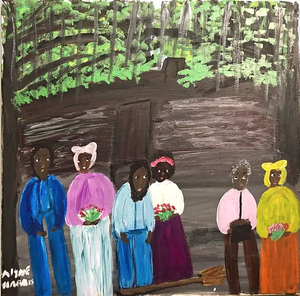
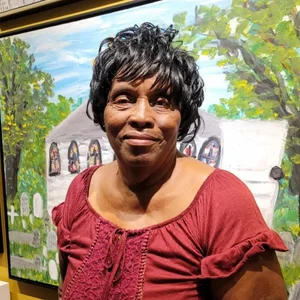
Alyne Harris is a folk artist native to Gainesville, FL and is a distant relative to sculptor Jesse Aaron (A sculptor and wood carver. Aaron began his path of creating art when he was in his early 80s. He rapidly gained recognition, earning a Visual Arts Fellowship from the National Endowment for the Arts). She grew up in the country and always remembers drawing in the dirt and sand. Nature is a key aspect of her art as it is something she loves. Birds and trees particularly are what she enjoys painting from nature. Her artwork overall is described by viewers as embracing the spirit of imagination.
Painting is a way for her to keep in touch with herself and her memories and share that with others. Harris includes themes heavily based on African American culture by depicting traditions and history with depictions of slaves and lost loved ones. For example, her artwork below is one of many that depict the African American wedding tradition of Jumping the Broom. The origins of Jumping the Broom are debated but it originates from Ghana in which the broom held spiritual value and symbolized sweeping away past wrongs or removing evil spirits. Jumping over the broom also symbolized commitment of the wife to clean and overall commitment to the house. Whoever jumped the highest, would be the decision-maker. The tradition continued in America as a remnant of the African culture that endured during slavery.
Rodney L Hurst Sr.
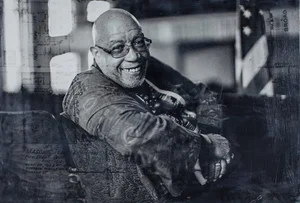
Rodney L Hurst Sr. is a writer and civil rights activist in Jacksonville, FL. He was eleven years old when he accepted his American History teacher’s invitation to join the Jacksonville Youth Council NAACP and he was 16 when he was president of it and helped to lead sit-ins. Hurst is active in his community in which he served on the Jacksonville City Council and is a member of many boards and agencies as well. Hurst has written a total of four books, all dealing with racism and civil rights in his local area.
Hurst’s first book, “It was never about a hot dog and a Coke®!”, tells of his personal account of Ax Handle Saturday along with an informative insight on Jacksonville during the 1950s and 1960s. Rodney Hurst tells of his account protesting during Ax Handle Saturday and running from the scene. A woman picked him up in her car and drove him to safety at a nearby church.
“Unless WE Tell It…It Never Gets Told!” is Hurst’s second book that tells stories about Jacksonville’s Black History and Civil Rights History. His third book, “Never Forget Who You Are: Conversations about Racism and Identity Development,” co-authored with Dr. Rudy F. Jamison Jr., discusses Racism and identity development as seen through their eyes. The fourth book, “Black and Brilliant,” is a young adult book based on his first book.

Mildred Thompson
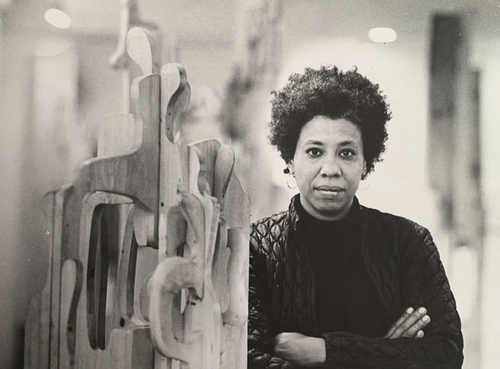
Mildred Thompson was an artist described as being ahead of her time and someone who did not stick to one medium. She was born in Jacksonville, Florida and left the state for university where she received her first formal art training with Howard University. She returned briefly to the state for a summer teaching job at Florida A&M University in Tallahassee. With the money from this job, she traveled to Europe gaining experience and inspiration from German art. She took this time to focus on incorporating wood in her art. Thompson set up a studio in West Germany after she went back to Germany in 1963 as she felt more accepted there compared to the discrimination and hardships she faced while pursuing her art in New York.
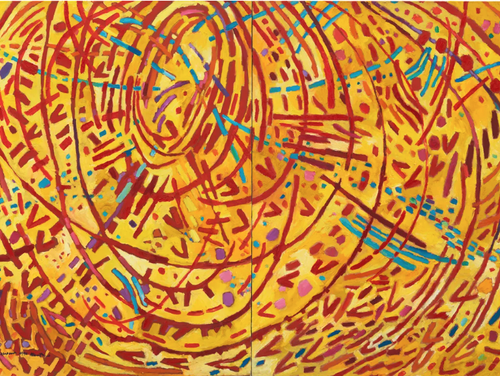
Thompson’s work is vibrant and abstract as she experimented with different forms and ideas in her art. When faced with criticism about her art not being symbolic enough or meeting societal standards, she proclaimed that “Everything I touch will be part Black and female.”